Showing posts with label teen. Show all posts

Saturday, 11 June 2011

I've seen him on the news. John Smith, out there, on the run. To the world, he's a mystery. But to me...he's one of us.

Yesterday I received an amazing little present in the post; a hardback proof copy of The Power of Six, the second in the Lorien Legacies series by Pittacus Lore. I adored the first book and have been anxiously awaiting this second offering.

If you haven’t read the first book, I Am Number Four, be aware that this review may contains Spoilers.

Nine of us came here. We look like you. We talk like you. We live among you. But we are not you. We can do things you dream of doing. We have powers you dream of having. We are stronger and faster than anything you have ever seen. We are the superheroes you worship in movies and comic books—but we are real.

Our plan was to grow, and train, and become strong, and become one, and fight them. But they found us and started hunting us first. Now all of us are running. Spending our lives in shadows, in places where no one would look, blending in. we have lived among you without you knowing.
 

But they know.
They caught Number One in Malaysia.
Number Two in England.
And Number Three in Kenya.
They killed them all.
I am Number Four.
I am next.


John Smith is Number Four and the death of yet another of the Garde, Number Three, has caused him and his guardian, Henri, to flee their home and find another, this one in Paradise, Ohio. John’s special abilities, or Legacies, begin to develop, bringing with them chaos and exposure.

As the battle between John and the Mogadorian scouts sent to kill him approaches, Number Six arrives, a blonde girl with a feisty attitude. Both decide that the plan to keep all the children apart will only destroy them eventually and battle the Mogadorians so that they can escape to find the others. Six and John leave, taking Sam Goode, a human ally, with them.

Power of Six follows on the story, but instead of John, we are focussed on Number Seven, a girl named Marina. Living in a convent in Spain, her guardian has abandoned her for God and Marina is forced to cope alone as her Legacies arrive, and with them, the threat of the Mogadorians.

I skipped through this book in all of about four hours, enthralled by the action and intensity in the writing. The extraordinary is definitely the key with the pacing, as each storm cloud, or night time excursion, brings with it the possibility of more Legacies or Loriens being revealed.

It is intriguing to read through Marina’s (Seven) story, and her fascinations with John Smith, and know all we know about the other characters. It pulls the reader in, as every moment that we’re involved we’re waiting for them all to find each other. Marina is a brilliant character on her own, but, from witnessing more scenes between Six and John, it will be great to see the dynamic this group pulls in once they’re all together.

This novel definitely feels more cinematic than the last, and perhaps that’s because of the reception of the first. There is a plan for six books, but, after the failure that was the first film, I don’t think the film franchise will happen alongside. I didn’t mind the first film, but whereas the book can cater to adults and teens, the film industry tends to feel it has to pick one age range. It went for teen and, unfortunately, ended up losing a lot of the subtly and maturity of the novel. On a visual point, the cover pictured is not the cover I had on my proof. Mine was white with a blue, embossed symbol. Much simpler and I definitely preferred it.

Battling against my rational brain at this point is, however, my disdain for author James Frey. The pseudonym Pittacus Lore covers James Frey and Jobie Hughes, and, to be honest, I have issues with Frey as a genuine author. After the scandal with A Million Little Pieces, I can’t really have any respect for that author. On a personal note, I really wish bookshops and libraries would stop promoting it as a memoir, because it’s mostly rubbish.

Either way, Power of Six definitely makes a great sequel to I Am Number Four. I’m super excited to see where the series goes after this!

Wednesday, 8 June 2011

Make no mistake, we are artists. We are athletes. We are bobble-heads.

Hellcats has been cancelled!

Now, I know this show didn’t exactly have a lot of intellectual merit but it wasn’t trying to be smart. It was trying, and succeeding in my opinion, to be a fun, frivolous little snippet of T.V., perfect for those wanting to relax and switch off their brains. I liked this show, I mean, my favourite film is Bring it On! so this was always going to be right up my street. And that’s exactly the market it should have been aiming at.

As far as I’m aware, it was being shown on the right kind of channels (UK = MTV, US = The CW) and the ratings weren’t atrocious. As the series progressed, they fell but, by that point, the episodes were more serious in nature and had a lot less dancing cheerleaders flying around the screen.

I was really interested in the story, and with the whole series ending in such a cliffhanger, I’m quite disappointed I’m not going to see how it plays out. Thing is, any show like this is an aspirational one; people watch it because they want to emulate the characters on screen and seeing them do things you can’t do (flip, dance, fly ten foot in the air and land safely back on the ground) is all part of that. By making Hellcats like every other CW drama, they took away its main appeal and it became just a slightly sub-par teen drama.

I am definitely realising it takes a lot to get a show renewed. Last year, I got into Privileged, which then got cancelled, and this year it’s been Hellcats that’s got the axe. I’m not saying that either of them were perfect but they could at least finish up the endings of the seasons.

On a positive note however, the CW is FINALLY letting go of One Tree Hill. That show has been dead since Peyton and Lucas skipped town, now all that’s left to do is bury the rotting carcass.

Monday, 18 April 2011

A story about a teenage wizard facing off against a dark lord beats one about a sparkling, lovesick vampire anyday.

So my teen fiction love affair remains unwavering at present. I wish I could say I was attempting to move on and be a grown up with my reading but I'm not. I like living sqaurely in my literary-youth. And because of that I was very excited to find this brilliant article on new teen movies ariving soon.

The Next Harry Potter or Twilight?

This little article is great - I was excited to find that Wake by Lisa McMann is being made into a film - although I think it's kind of funny that everything is supposed to be "the new Harry Potter/Twilight".

Nothing beats Harry Potter. And I shall be a Gryffindor till I die.

Actually, I'd probably be a Hufflepuff, but, you know, I like the idea of all that partying.

Tuesday, 12 April 2011

No one is looking for me. That’s the truth.


Entangled was picked up because of an intriguing blurb and, I’ll admit, a pretty cover, and I was looking forward to this teen mystery. Trapped in a room, with no idea how she got there, and encouraged to write down what’s happening, Grace begins to decipher her story. Problem is, as readers, the plot is entirely predictable from the beginning and the ‘twist’ at the end is more of a forgone conclusion. So as Grace figures out the root of all her problems, we’ve already sussed them out, called the psych ward, and had her thrown into therapy.

Clarke’s writing is well done; the problem here is such a basic plot. I’ve read a few reviews saying things like ‘I was on the edge of my seat!’ and the only thing I can say is, if you were, you’re obviously a little bit slow on the uptake. Clarke never makes any intention of hiding the outcome of the story from us, and as soon as Grace’s life starts to head downhill, it’s a struggle to keep reading.

It’s not that it’s a bad book. It’s fine. It’s just not exactly challenging. Now, I’ve made no secret of the fact that I enjoy reading teen fiction because, a lot of the time, it’s simpler and, because of that, more enjoyable. Thing is, simpler does not mean dumbed-down and, even though I wish it wasn’t, that’s exactly what Entangled is.

I didn’t hate it, even if it sounds like I did. Unfortunately, it just didn’t peak my interest once I’d got past the pretty pictures on the cover. I have no troubles with style, just please, next time, add a little substance in too.

Friday, 8 April 2011

A toast to Hell.

Do know what? Even after my rubbishing of this film on twitter, the longer I go since watching it, the more it sticks in my head. I can’t decide what’s grabbed me but I’m pretty convinced its the chance to read and adore the book part of this franchise before anyones even seen the film.

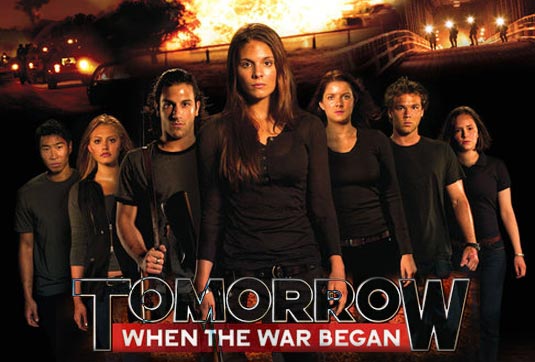
Tomorrow, When the War Began (or TWWB, as I’m now going to refer to it, it’s just too long otherwise) is the story of a group of Australian teenagers who decide to take a camping trip into the bush before school starts up again. While away, a foreign power invades and proceeds to take control of their town and the entire country. As the teens discover what has happened, they vow to fight back, refusing to let another nation come in and take away their homeland.

The movie was one I thought was pretty interesting when I saw the trailer a couple of months back. I had never heard of the books (although they are hugely famous in Australia) and it wasn’t until I looked into the film after watching it that I even knew they were books first. And it always sparks my interest to hear that. So I got around to watching the film, which was released over six months ago in Australia, and although I was nowhere near disappointed, it did feel a little low budget.

See this is what Hollywood does to us people. It ruins our ability to enjoy any kind of independent film that isn’t a small, intelligent drama. I like indie films, really, but having an action (I suppose that’s what it is?) indie film is very odd. That being said, I think they did well for having nowhere near the kind of budget I would imagine the Hollywood execs would have poured on it. Wonder how long it’ll take them to pick it up/do a remake? Actually, scratch that. They’d never do a film about America being secretly invaded and overpowered and a bunch of kids saving them. If they did, I would love to see it though.

The film = not great because of the lack of budget/special effects, but it was very entertaining. I wasn’t bored, wasn’t in the middle of anything else while watching the film, and, although the acting wasn't stellar, it was funny to watch what was essentially a very long, and surreal, episode of Home and Away unfold on my screen.

(Side note: Most of the actors have actually been in Home and Away or Neighbours before)
There is a second in production, due for release 2012, and that’s just as well because there are seven books in total and it would be great to see them all done. I don’t think the plot is thick enough for a full seven films but it would be cool for them to all be done by Australian production, with the same cast, however many they made.
There’s a big rise at the moment in really amazing teen book franchises and with Harry Potter and Twilight ending, there’s a big market for some new films to come out. Hunger Games has finally done some casting, the first in possibly many Lorien Legacy films came out earlier this year (I Am Number Four), and the Gone series, Wicked Lovely, and Forest of Hands and Teeth (which I’m reading now) have also been optioned for film.

It is a good time to be into the teen fiction.

Thursday, 7 April 2011

Once you're in the air, there's nothing you can do but let go.

As is obvious from previous reviews, I have a bit of a pre-occupation with certain genres of fiction. The teen death thing is a big one for me and I suppose it stems from the same place as a fascination for tv shows like Waking the Dead and Bones. I’ve gone into this before so I’m not going to repeat myself but, suffice to say, I do love books with this deeper meaning; the struggle, as it were, between life and death.

Before I Fall follows one repeating day in Samantha Kingston's life. Fairly soon into the beginning of the book, our main character dies in a car accident. She then wakes up to find herself starting the same day over again. And so it continues.

High school is hard and Sam has climbed her way through the social ranks to make life easier on herself. In doing so, a lot of people have been pushed aside and this story is, in this way, a typical ‘popular girl sees the error of her ways, discovers what life’s really about, blah blah blah ’. Thing is, the spin on this, the repeating days, giving her chances to fix all her wrongs, is definitely interesting. It’s not entirely unpredictable though. Once you reach a certain point in the story, you can kind of see where it’s going to end up, although how she gets there is executed well.

Before I Fall is above all a beautiful novel. Oliver’s prose style and her ability to give us a different take on each repeated day is really spectacular. It’s also the first book in a little while to really grab me and give me that ‘I really want to finish it but I don’t want it to end’ feeling. It also had me sobbing my heart out at midnight as I finished it, which to me, is always the sign of a story and a character that has really sunk in. Considering I only picked it up because I was interested in Oliver’s new novel, Delirium, I’m certainly glad I did.

Many, many urgings for you to read it.

Friday, 25 March 2011

You’re a wintergirl, Lia-Lia, caught in between the worlds. You’re a ghost with a beating heart.

I recently read Wintergirls by Laurie Halse Anderson, author of Speak. I always find books about anorexia strangely fascinating, ever since I was in my teens. The idea of girls who would voluntarily give up food astounded me and I was desperate to get inside their heads. One of the first books I read on the subject was The Best Little Girl In the World by Levenkron, and I’ve been hooked since then.

Wintergirls starts just as Lia, a seventeen year old anorexia sufferer, finds out her old best friend, Cassie, has died, alone, in a motel room. On the night she died, she called Lia thirty-three times. Lia didn’t pick up. And so continues Lia’s ongoing struggle to be thin. To beat Cassie. Even if it means losing everything else first.

Anderson is a pillar of troubled teen fiction and I adored this book, just as I did Speak. Lia’s obsession with food is enormous, driving her to tamper with the family scales, and pour washing up liquid down her own throat. I did love the book and truly have practically nothing bad to say about it. The only thing I possibly wanted was a little more explanation towards the title. It could have been that I simply missed it in my haste to finish the book but I felt that, although it was a great idea, it needed a little more expansion.

Like I said, only that tiny niggle. Otherwise, it was a book I thoroughly enjoyed and would recommend to many.

Thursday, 24 March 2011

Afflicted by love's madness all are blind.

Right. So. I actually did a bit of writing and finished a few books this week, hence the no blog-hiatus. But now, I shall do a couple ickle reviews.

First off, I had A Note of Madness by Tabitha Suzuma. She wrote a book I previously reviewed, Forbidden, and I was intrigued to check out her other stuff. I also liked the fact that she’s a British writer (they seem increasingly hard to find) and she was writing about a musician battling with depression. It seemed like an fascinating idea.

Our main character, Flynn, is a student at the Royal College of Music, preparing for an important concert. He begins to experience mad flashes of inspiration, days when he can compose all night and study all day, followed by days when he can’t lift his head off the pillow. His friends and family are concerned, and as Flynn spirals deeper into a bad spell, can anything pull him out?

I found the book interesting, but unfortunately did not feel quite as compelled as during my reading of Forbidden. Flynn was the perfect character and although I liked him, I couldn’t feel much for the other people in the book. Their characterisation was difficult; Flynn kept revealing distant memories about the other characters and I felt confused that I hadn’t known about them earlier. It was good to read about a condition I know little about and I found the prospect of so many different drug concoctions mind boggling, as did Flynn.

I have since looked into more of Suzuma’s work and I was startled to find every novel she has written focuses around some form of mental health issue. Going through the same thing in her own life, I can understand her fixation on the subject and the catharsis it brings writing about it. However, although her other books do sound interesting I think I may have to give them a miss. Too much writing by one author on the same subject and I find the stories tend to blend together, till each one sounds the same. It’s very similar to reading Jodi Picoult.

Friday, 11 March 2011

To die would be an awfully big adventure.

I’ve been reading quite a few books about the afterlife recently and it’s odd how Teen Fiction seems to focus on this quite a lot. A while ago, I reviewed a book called If I Stay by Gayle Forman which I really enjoyed, and a sequel is also on its way. Although teens are not exactly the closest age group to death, I think it’s definitely something you start thinking about a lot more when you’re that age. It’s also, I feel, the time when you’re most afraid of dying. You’re old enough to realise the significance of death, your own proximity to it, yet not old enough to have really experienced anything. When you’re feeling isolated in so many other ways as a teen, death just seems like a final way for you to be shut out of people’s lives, including your own.

I know I definitely thought about death a lot more as a teenager than at any other time in my life. I was madly afraid of dying; I couldn’t even bear hearing people talk about it hypothetically. It wasn’t until I went to University that the fear decreased. I was living, really living; therefore I didn’t have to be afraid of dying. I certainly don’t want to die, and would be very pissed if I died now, but I know that, statistically, it’s unlikely, and that, even if it does happen, I will have at least accomplished a few things in my life.

I think for teenagers that just isn’t there, and that’s why the idea of death and dying becomes, for some, a pathological fear, and, for others, a strange obsession. Obviously, there are many wonderfully, well adjusted young adults out there who simply deal and get on with it, but then when has teen fiction ever been about them?

Both of the books I want to talk about have similar ideas of the afterlife. Their characters inhabit a ‘heaven’ that works almost identically to the living world. People have jobs, own houses, drive cars, and pursue relationships, just like they do when alive. In both books, however, there’s a catch.

In Elsewhere by Gabrielle Zevin, Liz dies in a hit-and-run, aged only fifteen. She wakes up on her way to ‘Elsewhere’, a place where life does go on, except it goes on backwards. For every year spent in Elsewhere, Liz grows a year younger, yet this never stops her enjoying her after-life just like her first.

This book was great. To be honest, I don’t read a lot of funny fiction, and although this was by no means a comedic novel, it was very whimsical and sweet. Generally, everything I read is depressing, or dark, or very heavy, but even with a dead teenage protagonist, Elsewhere never feels like it’s a book about death. This is most definitely a book celebrating life, and all the wonderful things you can experience. It’s not a hardcore read, and is probably aimed at the younger end of the teenage market, but it was nice to read something light for a change and I think it offers an inventive take on the typical afterlife dilemma in fiction.

The other novel I read was The Brief History of the Dead by Kevin Brockmeier. Originally released as an adult novel, it has become a crossover title, possibly because of its length (it is only 250 pages), and its lack of overly complicated language. Although I read it believing it to be a piece of teen fiction, I did feel that it would work just as well as a short adult read.

The book centres on the African tribal belief of three categories of human; those still alive on Earth; the recently departed; and the dead. When people die, they become the recently departed, as long as someone still alive on Earth remembers them. In this novel, a deadly virus begins to wipe out the population of the world, taking many of the inhabitants of The City (where the recently departed go) with it. As the novel progresses, more people disappear, until only people known to Laura Byrd, the one woman left alive on Earth, remain.

The novel raises some interesting ideas about memory and how a person can ‘live on’ in our minds. I had never heard the three categories belief before, but I find it a very interesting way of looking at life after death. The idea that family and friends can continue to be alive in our memories is a common one, albeit one that Brockmeier takes to an extreme.

It is, however, interesting to think of how many people you can remember if you really think about it. At one point in the novel, the character Puckett attempts to count all the people he can remember. In the end, it becomes an impossible task but he estimates each person would recall between 50 and 100,000 people. I am going to attempt to do this at some point, count all the people I can remember. My memory is notoriously bad so I’m sure I won’t get anywhere near that number but it’s an interesting task in any case.

Brockmeier’s novel has an interesting premise and a likable main character. I do feel that the story would have played out better as a set of short stories, published together, but playing out independently of one another, or perhaps as simply one short story. I didn’t particularly enjoy the continual swapping between characters; although many other books have done it, and done it well, I felt it distracted me here. I would have preferred to read Laura’s story on its own, then stopped and read Luka’s story and so on. It is, in my opinion, a perfectly fine book, but nothing outstanding.

Wednesday, 9 March 2011

It’s just that I’m tired of being compared.

Over the last couple of weeks, I have indulged in something truly satisfying. I have laughed, I have cried, I have wanted to throttle, and I have wanted to console. Mostly I have been ashamed.

I have been watching a 90’s teen television show.

I have been watching Popular!


Brain child of Ryan Murphy, God of all things Glee, Popular! is a show set in high school about two girls from opposite social spheres whose parents get engaged. Chaos ensues as social barriers come tumbling, and crashing, down around them and force they, and their friends, to discover what it really takes to be popular.

It is a total guilty pleasure show; it’s ridiculous, stupid and downright absurd at practically every moment but it’s also hugely entertaining. The characters are brilliant, with just the right amount of randomness to make them believable, and every word of the script is golden.

The problem with many teen dramas is that they’re just too polished. The characters are too beautiful, too smart, too one dimensional to really make you believe in them. In Popular! each character displays such a myriad of emotions and characteristics that you start to think of them as real. People, especially teenagers, are confusing, unreliable, hypocritical, and change their mind as often as the wind, so why should teen characters not portray that? I love the fact that this show, in the same vein as Glee, also shows the funny side of everything. It takes the piss out of itself at every turn and never once apologises for it. An episode in Season Two, for example, sees the chemistry teacher, Ms Glass, write and direct a production in which the students play sexually transmitted diseases and perform to primary school children. Now that would (probably) never happen in a regular high school, but in Popular! it's completely normal.

It’s a shame that the show was cancelled after only two seasons. It ended on a massive cliff-hanger (life or death type cliff-hanger) and, apparently, the show’s producers had no idea the show would be cancelled. Even so, it’s still worth watching. If you enjoy shows like One Tree Hill, The O.C., and, of course, Glee, then it’s definitely worth seeing if you can get hold of Popular!

Monday, 7 March 2011

What you do, the way you think, makes you beautiful.

Uglies by Scott Westerfeld is a book that, when I heard about it, I instantly knew I wanted to read it. It sounded brilliant; in a world where everyone becomes ‘pretty’ on their sixteenth birthday, what does is really take to be beautiful? It had so many of my favourite teen fiction aspects; dystopian future, check; evil, sneaky government, check; band of misfit rebels, check; and morally ambiguous characters, check. It had so much going for it and I was disappointed that it didn’t live up to my expectations.

It didn’t grab me. That is literally the bulk of my problem with this book. Everything about it screamed that I would love it and I just didn’t. The plot was well constructed, the characters fully three-dimensional, and the bad guys suitably bad-guy-ish but I just didn’t get anything from it. I felt it plodded, rather than skipped, and I couldn’t bring myself to care at all about the characters. The protagonist, Tally, was whiney and sullen, and didn’t seem particularly enthusiastic about anything in the novel and, unfortunately, I feel that it transferred to the reader.

Now, the Uglies series has been widely read, and praised, and I don’t doubt that many people loved it. I have rented out the second and third novels in the series, Pretties, and Specials, and I’m hoping that reading about the same character a little more will endear this series to me. I’m not really holding out any hope but I challenge Westerfeld to make me love these books.

I do have to say, I love the premise of the books. I think it is a brilliant idea and, once again, is does seem likely to me that something of this nature will become the norm in society. Plastic Surgery is getting cheaper, is widely available and the stigma previously attached to it is decreasing. So who knows? However, Westerfeld’s novels do raise the interesting point that if everyone is beautiful, then really it transpires that no-one is. Our flaws and our imperfections are part of who we are, part of what makes us beautiful. Take away that, you take away all individuality and all you-ness. I think it’s a great message, especially with MTV and E! warping all our minds (including my own). I love this message, even if I didn’t love the novel itself.

Tuesday, 8 February 2011

Just in case the world ends tomorrow, we might as well enjoy today.

Oh Dear Lord. The amount of excitement I had for this book cannot be explained. I adored Life as we Knew it, was under whelmed by Dead and the Gone and have been trying to get the finale, This World we Live in, for what feels like an eternity. And although I loved it, I am so annoyed that I built it up.


This World we Live in follows on from the two previous Last Survivors books, with Miranda Hart and family still struggling to survive in Pennsylvania. As the book begins, they are coming to end of the incessant winter freeze, though it brings no less worry than before.

It was good. It wasn’t amazing, like I thought it would be, and it wasn’t terrible but it wasn’t at all what I was expecting. Having known a little of the plot beforehand (Amazon gives away quite a significant chunk), I spent many chapters unhappily waiting for things to happen. The arrival of Miranda’s father and the other characters is actually quite a way into the book, so I felt much of what happened before that was filler. Nothing in this instalment seemed quite as desperate as in Last Survivors #1, perhaps due to the larger number of characters, and the book was also significantly shorter.

I did enjoy the book but I feel that what with Amazon’s spoilers and the wait-time I had on the book it wasn’t as good as it could have been had I read it immediately after #1. This book does, however, make Dead and the Gone (#2) more relevant, as Alex’s behaviour in This World we Live in is more justifiable within the context of the book. I still think the overall series was great but, unfortunately, I’ve read better end-of-the-world stories. I would still recommend Life as we Knew it on it own, but, although they round off the story, the cliff-hanger in the first book is best left that way.

Monday, 7 February 2011

You can close your eyes to the things you do not want to see, but you cannot close your heart to the things you do not want to feel.

On my forays through the interweb, I have come across quite a few sites detailing the best books for this genre, and the best types of this fiction. The most comprehensive one I’ve come across, by far, has been the TeenReads Ultimate Teen Reading List. I’m pretty sure I’ve swiped a large majority of it and put it in my TBR list (which is way longer than the one on the right) and one of my most recent reads from it has been Forbidden by Tabitha Suzuma. To give you a little taste, the blurb reads like this,


She is pretty and talented - sweet sixteen and never been kissed.
He is seventeen; gorgeous and on the brink of a bright future.
And now they have fallen in love.
But . . .
They are brother and sister.

So, pretty messed up to begin with. Now, I’ve spoken about Wideacre before on this blog, so it’s safe to assume I’m not scared by a little incest. My theory is always that if an author can write it well, and produce a believable storyline and characters from it, then it’s just another plot device, the same as any other. People read about murder all the time and no-one gets up in arms about it, so why this? There is very little in fiction that is off limits and I like it that way; censor one topic and you might as well censor them all. As long as it is written for literary reasons and not sensationalist ones, then it’s fine by me.

On that note…

The brother and sister in question in the novel are Lochan and Maya, seventeen and sixteen respectively. With an absentee father, and a barely-there mother, the two are left to look after their three younger siblings. They have, over time, become the surrogate parents; assigning chores, controlling bedtimes and enforcing rules. With Lochan’s final year exams approaching, and their mother around less and less, the responsibilities of the two become overwhelming and they seek comfort with each other.

Because of their unusual upbringing, Lochan and Maya never really come across as brother and sister, a thought which is echoed by Maya in the book. They are doomed by a genetic accident, yet they have never truly been siblings. The ‘incest’ portrayed in the book then always feels only technical; you find yourself justifying the relationship along with the characters. It’s not something I can say I agreed with but it’s difficult to find a way to condemn it as well. Part of what makes Forbidden such a great book is how it manages to make you feel like this.

I found myself completely rooting for the couple throughout the book; it did take me tearing myself away from it (at work for example) to remind me that they were brother and sister. Suzuma is such a beautiful writer, and this book is definite proof of that. I found myself full on sobbing at the end of the book, and I urge people, whatever your preconceptions, to read this book. It’s not pro-incest, or anything even close, it’s just a very well written TF novel that explores the dynamics of a relationship so destined to fail.

Friday, 4 February 2011

When people don't express themselves, they die one piece at a time.

So I am excited about my library hoard this week. I went to the big, depressing library on Tuesday to pick up a few reservations and got Speak by Laurie Halse Anderson, Forbidden by Tabitha Suzuma, and, for a little re-read, Life as we Knew it by Susan Pfeffer. On Saturday, I’m planning on visiting my actual local library for the first time and picking up a few more reservations, namely, Uglies by Scott Westerfield, How I Live Now by Meg Rosoff, Elsewhere by Gabrielle Zevin and then, the reason for my Pfeffer re-read, the finale of The Survivors Trilogy, This World we Live in.

I finished Speak at lightning speed; I’ve heard really good things about it and it’s on loads of ‘must read/best of’ lists so thought I’d give it a go. I’ve also found out a TV movie was made of it, starring none other than Kristen Stewart as the main character. I’ve not watched it (although I’m sure Stewart’s acting stands out as immensely wooden as always) but I always like to see adaptations of books so I’m on the hunt. The book itself was really well done, the writing believable and the main character, Mellie, relatable. The plot was interesting and honestly kept me intrigued. The crux of the story wasn’t an unfamiliar one for TF but Mellie’s silent protest make it more unique.

However, for all its good points, Speak does fall down a little for me. I, like Mellie, kept the same friends all through primary and secondary school. In fact, many of them are still my friends now. I cannot believe that friends who were as close as Mellie describes herself, Rachel, Nicole and Ivy would fall out over something like a party. They may fight about the phone call but there would definitely be some serious grilling of her real reasons. Friends like that should know her well enough to sense something was wrong. Also, although I think Anderson keeps Mellie’s appearance vague so she’s more of an every-girl, I found it distracting. It annoyed me that I couldn’t get a definitive picture of her in my head, in large part, due to the lack of description.

Speak was a great book to read although it’s definitely suited for younger readers than myself (well duh!). I’d say its at the lower end of the teen spectrum, even though the issues it deals with are unsettling.

Thursday, 3 February 2011

The line between Y.A. and adult has become almost transparent.

I’ve realised I’m getting a little obsessed with the teen fiction. I like the ease of reading it. With adult fiction you often have to work quite hard to discover and enjoy a novel. There are complicated twists and involved reasoning, which are used to develop the intricate and detailed characters. None of these are bad things, in fact, they show great skill but sometimes it’s nice not to have to work at it. Teenage fiction, although by no means less involved, is written with pure entertainment in mind. It’s easier to read because, although there are twists and tricks, they are less dense. Also, in TF (as I’m going to call it) there is generally always one central theme. Love. Whether it’s a simple coming-of-age story or an alien invasion tale, there is always a part of the novel tied in with relationships. And that is something everyone can relate to. Everyone remembers their first crush, the first person they kissed, the first broken heart. That experience is one of the few that ties us together as a species, something that makes us human. So that’s why I keep returning to TF; to experience that first love all over again.

Wednesday, 26 January 2011

It's a brave new world.

The other day, I found myself wandering through the aisles of WHSmith’s, armed with a £15 gift voucher. I was on the lookout for something I hadn’t read, but was certain I would enjoy. I have a bit of thing with buying books; I want to know, beyond a doubt, that I’m making an investment. The book either has to be something I’ve read and know I’ll want to recommend or read again, or a book by an author I’ve read before. Generally, I don’t buy books I’ve never heard of, by authors I don’t know. However, Smith’s is not the best place to book browse with such specifics in mind so I wound up staring at their teen fiction, my never-fail fall-back option. And so I managed to discover two pretty cool things.

1. Because of the Teen love of all things supernatural, some Christopher Pike books have been re-released. Be still my heart.
2. Many, many, many of the popular teen books (a large majority of which are now supernatural or sci-fi based) were on a Buy-One-Get-One-Half-Price offer. Result!


So I picked up Pike’s Remember Me Volume 2 (I have book one hidden away somewhere, an old Point Horror edition, ah memories) and 0.4 by Mike Lancaster. Now 0.4 I’d never heard of. I’d never seen an advert or any promotional material. It wasn’t on my ever increasing list of must-read teen fiction. So, for the life of me, I have no idea why it intrigued me. The cover was pretty cool, the blurb vague but fascinating, and the tape recorder aspect reminded me of 13 Reasons Why, another teen book I read last year. So maybe that’s why. But once I’d picked it up, it did pull me in. The writing was pacy, the characters interesting, but not overly formed, and the action began almost immediately. The interruptions throughout the narrative from the blank bits of tape and the scholarly interludes added a feeling of depth to an otherwise fairly straightforward invasion scenario and that was definitely welcomed.

However, Lancaster’s book, although great, is quite simplistic (even for TF) and I feel it could have done with being a little longer. The concept is actually quite an interesting one and it’s a shame that certain aspects of the text make the possibility of a sequel seem remote. I would recommend it if you like a bit of light sci-fi but it’s one to find in your library rather than the bookshop.

Friday, 21 January 2011

Four mages. One destiny. No turning back.

Finally got around to reading the final (as far as I’m aware) book in the Circle Saga by Tamora Pierce, The Will of the Empress. It sees our four mages, Sandry, Briar, Tris and Daja, go to visit Sandry’s cousin, the Empress of Namorn after a long period away from each other. They have grown apart and have closed the connections between their minds and their powers. While there, it becomes apparent that the four have stepped into a trap and it takes all their skills, and them accepting the changes in each other and in themselves, for them to fight and escape the Empress.


I haven’t read Tamora Pierce books in a while but I stumbled across this book when, a few months ago, I ‘Googled’ Pierce. I had just finished re-reading the two Circle Quartets and was intrigued as to whether anything more had been done with the characters. Unfortunately, Pierce has fallen out of favour in the UK over the past ten years and finding a copy of Will of the Empress proved difficult. It took me moving to a new borough before I managed to locate one in my, now local, library system. It seems a shame that so many libraries are facing closures and budget cuts when, sometimes, the only way to really enjoy reading is in your local library. I probably could have bought the book online if I’d wanted to but not everyone has the luxury of being able to buy something just to sample it. We have an amazing system that lets us take books, CDs, DVDs, and much more home on the basis of pure trust that we’ll bring it back. Why would we want to wreck and destroy that? Take away the libraries and you take away many peoples only access to literature and that is always a bad thing.

Many of my weekends as a child were spent roaming around my local library, picking up and discarding titles, before heading, usually with more than my allocated 14 books, to the checkout desk. My mum would often end up with half of her allowance used on my books. As soon as we stepped in the car, I was ploughing into the first title and would usually have finished at least two books by the first evening. The Diary of Anne Frank, Junk, C.S. Lewis, Little Women, Jacqueline Wilson and so many other great writers and novels were books that I first picked up off of library shelves. I would really hate to think that other children and teenagers are being deprived of the wonderful freedom that comes from reading, taking you out of your life and inhabiting somewhere more fantastical.

I’m sorry, I’ve rabbit-ed on. I would just be angry if Library funding problems caused them to begin closures. But enough of that for now.

So I read the Pierce. In a day. And then the next day I started on Lies by Michael Grant. FINALLY! I have been desperately waiting for this paperback to come out but I got bored waiting so I just reserved the hardback from the library (back to that wonderful library) and guess what? Finished that in a day too.

I am constantly in awe of teen fiction writers. I genuinely believe they have a much tougher job than writers of adult fiction since the teen is an infinitely harsher critic. A teenager (this is all generalisation, obviously) will pick up a book based on the blurb, or presentation or possibly that a friend has recommended it. They do not care what prizes it has won, or been nominated for. Once chosen, the teen will begin to read. If it doesn’t grab them in the first page, that’s it. The book is done for. There is no recapturing that first impression. An adult reader, however, will struggle through, spurred on by the Booker Win or the Everybody’s Talking About stand at their local bookstore. Writing for teens not only takes a killer idea, but it takes a killer pace. You can’t lose focus, because if you do, so will the teenager. They can bear a few pages of boring, even a few chapters, but a couple hundred pages are not going to cut it. I remember reading Tess of the D’Urbervilles at sixteen; I skipped 100 pages and still understood the story – obviously everything I’d missed had been filler.
With all that pressure, it’s understandable that teenage fiction is often more violent and sexualised than adult fiction; it has to be to draw and keep the attention. Most teenagers are well versed in the playground gossip version of sex, violence and drugs so giving them an informed adult perspective, through the medium of teenage narrators and characters is possibly a good strategy.

Any-who, I’m heading off topic and running on a bit so I think I’ll wrap it up here; Lies was an amazing book and now I’m just desperately waiting for Plague, the fourth book in the series. Not out till April - damn my impatience!

Farewell folks!